
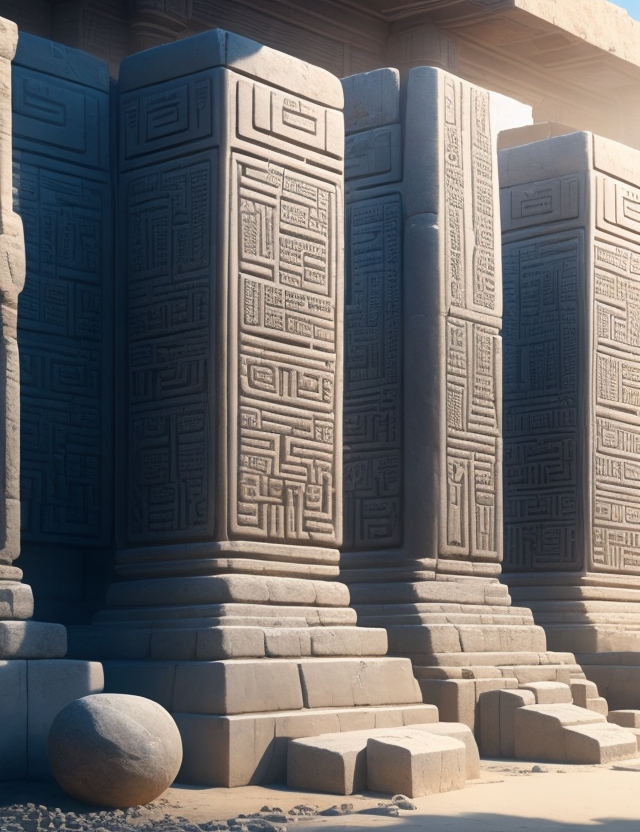
Part 1: “AI Bot Translates Dead Ancient Languages: A Revolutionary Discovery”
Welcome to the first installment of our five-part series exploring the intersection of artificial intelligence (AI) and ancient languages. In this opening post, we delve into a groundbreaking development that’s causing a stir in the world of Assyriology.
A team of researchers has harnessed the power of AI to translate ancient languages, specifically Akkadian and Sumerian cuneiform. This revolutionary discovery has the potential to transform the field of Assyriology and our understanding of ancient civilizations.
Cuneiform, one of the earliest known systems of writing, was used to inscribe messages in clay tablets over 5,000 years ago. These tablets, discovered in various archaeological sites around the world, provide invaluable insights into ancient societies. However, translating these tablets is a complex task, requiring specialized knowledge and a great deal of time.
To address this challenge, the researchers developed an AI model that can translate Akkadian, a language once spoken by people living in Mesopotamia, one of the world’s first civilizations. The model, an extension of the Babylonian Engine, a platform for digital Assyriology, uses a neural network to translate the ancient script into English.
This development is a testament to the power of artificial intelligence in bridging the gap between the past and the present. It opens up new avenues for research and discovery, allowing us to delve deeper into the rich tapestry of human history. As we continue this series, we’ll explore the implications, challenges, and future of this fascinating intersection of technology and history.
 Ruins and Relics