
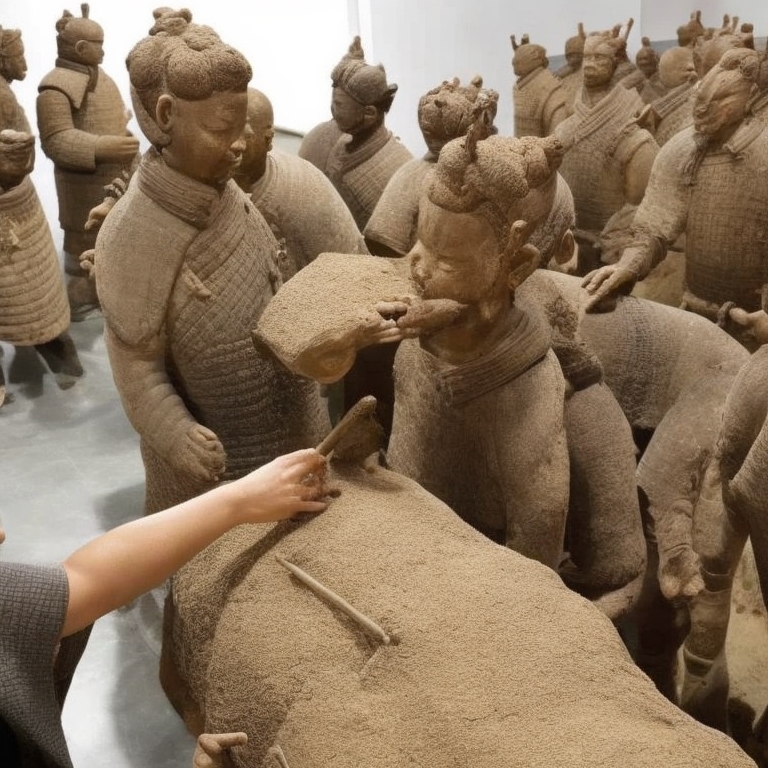
Welcome to the second installment of our five-part series on Archaeological Discoveries That Changed History. In part one, we explored the Rosetta Stone’s role in deciphering ancient Egyptian hieroglyphics. Today, we journey to China to uncover the secrets of the Terracotta Army, a discovery that shed light on the life and reign of China’s First Emperor, Qin Shi Huang.
In 1974, farmers digging a well near Xi’an, China, stumbled upon fragments of terracotta statues. Little did they know, they had uncovered one of the most significant archaeological finds of the 20th century. The Terracotta Army, a collection of over 8,000 life-sized statues of soldiers, horses, and chariots, was created to accompany Emperor Qin Shi Huang in the afterlife.
The Terracotta Army is more than a stunning artistic achievement; it’s a window into the world of ancient China. Each statue is unique, with individual facial expressions, hairstyles, and armor. The attention to detail provides insights into the military organization, weaponry, and cultural practices of the time.
Emperor Qin Shi Huang, the first emperor of a unified China, was a ruler known for his ambition and grand projects, such as the Great Wall of China. The Terracotta Army reflects his desire for immortality and his vision of ruling an eternal empire.
The discovery of the Terracotta Army has had a profound impact on our understanding of Chinese history and art. It has become a symbol of China’s rich heritage and a testament to the creativity and craftsmanship of its ancient civilization.
As we conclude this part of our series, we reflect on the Terracotta Army’s significance, not only as an archaeological marvel but as a cultural treasure that continues to captivate the world. Join us for part three, where we will explore the Dead Sea Scrolls and their role in understanding ancient biblical texts.
Citations:
 Ruins and Relics