
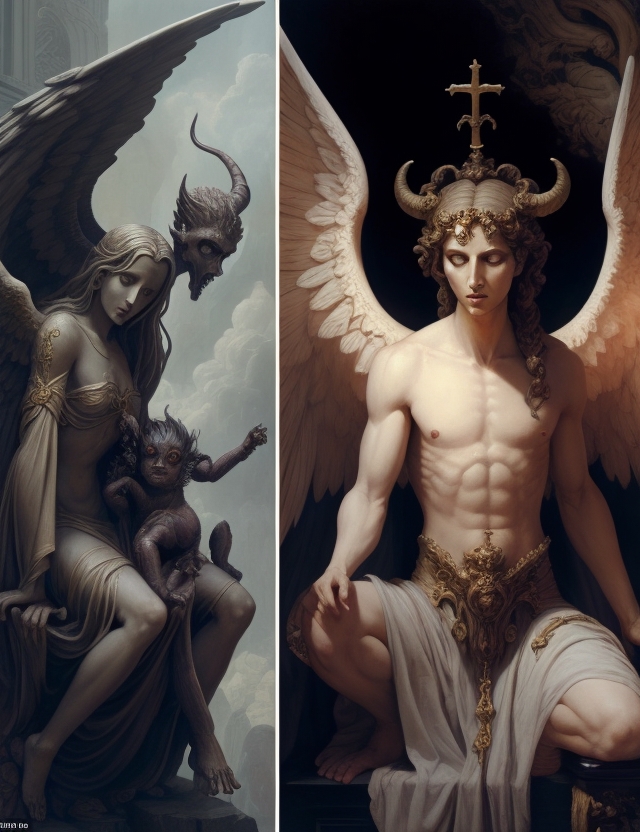
As Halloween draws nearer, our exploration into the enigmatic world of demons continues. In the first part of this series, we journeyed through ancient civilizations and modern interpretations to understand how these malevolent beings have been perceived across time and cultures. Today, we delve deeper into the Christian understanding of demons, tracing their origins and roles in religious texts and folklore.
The Christian Pantheon: Angels Turned Demons
In Christian theology, demons are often considered fallen angels who rebelled against God. Led by Lucifer, these angels were cast out of Heaven and became the demonic entities that roam the Earth, seeking to lead humans astray. The most famous account of this rebellion is found in John Milton’s “Paradise Lost,” although the concept predates the epic poem.
The Seven Princes of Hell
Christian demonology is rich with hierarchies and classifications. Among the most intriguing are the Seven Princes of Hell, each representing a cardinal sin. Lucifer embodies pride, Mammon stands for greed, and Asmodeus personifies lust, to name a few. These demons are not mere symbols; they are believed to actively work against human virtues.
The Role of Exorcism
The practice of exorcism, the ritualistic expulsion of demons, has been a part of Christian tradition for centuries. The New Testament recounts several instances where Jesus casts out demons from afflicted individuals. Over time, the Catholic Church formalized the rite of exorcism, and it remains a controversial yet enduring practice.
Demons in Protestantism
While Catholicism has a rich tradition of demonology, Protestant denominations have varying views on the subject. Some, like the Pentecostals, actively engage in spiritual warfare against demonic forces. Others, like the Lutherans, focus less on demons and more on the individual’s relationship with God.
Demons in Folklore and Superstition
Beyond the confines of religious texts, demons have found a home in folklore and superstitions. In medieval Europe, witches were believed to be in league with demons, leading to the infamous witch trials. Folk tales often feature demonic entities that make deals with humans, only to betray them later. The tale of Faust is a classic example, where a man trades his soul to a demon for worldly gains.
Demons in the Modern World
In today’s world, the belief in demons is not as widespread as it once was, but it has not vanished entirely. Some Christian denominations still practice exorcism, and the concept of demonic possession continues to be a subject of debate and fascination. In popular culture, demons are often portrayed as malevolent forces in horror films, books, and video games, serving as a metaphor for the darker aspects of human nature.
The Psychological Perspective
Modern psychology offers another lens through which to view demons. Carl Jung’s theory of the “shadow self” suggests that demons can be seen as manifestations of our repressed fears and desires. In this view, the battle against demons is an internal struggle, a quest for self-understanding and growth.
The Complexity of Demonic Entities
As we’ve explored, the Christian understanding of demons is a complex tapestry woven from religious texts, folklore, and modern interpretations. These entities serve as a mirror reflecting our deepest fears, ethical dilemmas, and moral choices. They challenge us, frighten us, and even inspire us to confront the darker corners of our souls.
As the leaves turn golden and the nights grow longer, our October Halloween celebration invites you to ponder the enigmatic figures that have haunted humanity’s collective imagination for millennia. Whether you see them as fallen angels, psychological archetypes, or cultural constructs, demons remain a compelling part of our shared human experience.
 Ruins and Relics