
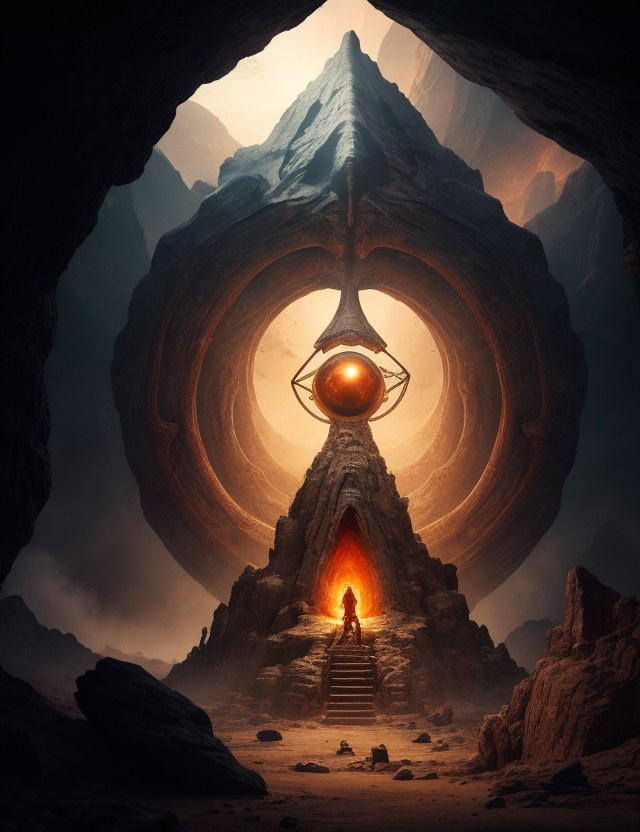
As the final days of October approach and Halloween looms on the horizon, we come to the concluding chapter of our exploration into the enigmatic realm of demons. Having traversed the landscapes of ancient civilizations and delved into the Christian understanding, we now turn our gaze towards the theories that seek to explain the origins of these malevolent beings.
Prehistoric Theories: The Dawn of Fear
Before the advent of written language and organized religion, early humans likely had their own interpretations of what we now call demons. Cave paintings and primitive sculptures suggest a belief in spirits and supernatural entities. Some anthropologists theorize that these early “demons” were personifications of natural dangers like predators or natural disasters.
The Elemental Theory: Forces of Nature
In various cultures, demons are often associated with elements like fire, water, air, and earth. These elemental demons serve as cautionary figures, embodying the destructive potential of the forces they represent. For example, in Japanese folklore, the Kawa-no-kami are river deities that can either provide a bountiful catch or bring devastating floods.
The Alien Theory: Extraterrestrial Origins
A more modern and controversial theory posits that demons could be extraterrestrial beings. Proponents of this idea point to ancient texts that describe “gods” descending from the sky, suggesting that these could be misinterpretations of advanced alien technology. While this theory is not widely accepted, it adds another layer of complexity to our understanding of demons.
The Psychological Archetypes: Jung Revisited
As mentioned in the previous article, Carl Jung’s concept of the “shadow self” offers a psychological perspective on demons. Some theorists extend this idea to suggest that demons are collective archetypes, shared fears or concepts that have been embedded in the human psyche over millennia.
The Cultural Exchange Theory: A Melting Pot of Malevolence
Demons are not confined to any single culture or religion; they are a global phenomenon. This has led some scholars to propose that the concept of demons has evolved through cultural exchange. As civilizations interacted through trade, war, or diplomacy, their spiritual beliefs—including their understanding of demons—blended and adapted.
The Moral Compass: Demons as Ethical Tools
Regardless of their origins, demons serve a functional role in many societies as cautionary figures in moral and ethical teachings. From Aesop’s fables to modern-day parables, demonic figures serve to illustrate the consequences of immoral behavior, thereby reinforcing societal norms and values.
Concluding Thoughts: The Everlasting Allure of the Abyss
As our October Halloween celebration comes to a close, we leave you with this thought: demons, in all their terrifying glory, serve as a complex mirror reflecting the human condition. They encapsulate our fears, our curiosities, and even our hopes. Whether they are ancient deities, psychological constructs, or something entirely different, their enduring presence in our collective consciousness is a testament to their intricate role in the human experience.
 Ruins and Relics