
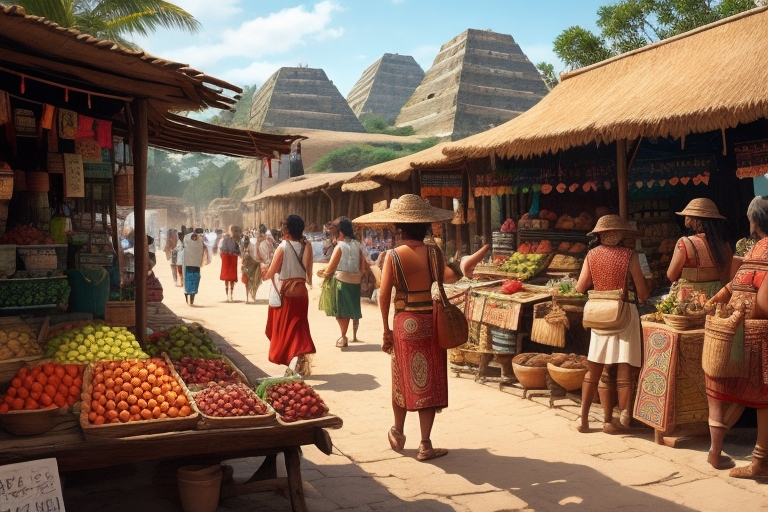
If you were to step into a marketplace in ancient Mesoamerica, you’d find yourself amidst a hive of activity. Vendors would be shouting out the merits of their goods, from colorful textiles to intricate pottery. But what might catch your attention is the unique form of currency: cacao beans. Yes, the same beans that give us chocolate were once the lifeblood of Mesoamerican commerce.
Cacao beans were more than just a form of currency; they were a symbol of economic power. The beans were difficult to grow and required specific climatic conditions, making them a valuable commodity. They were often stored in carefully crafted pouches, and their ownership was a sign of wealth and status. Cacao was not just used for small transactions; it was a standard measure of value, often used in trade agreements and tributes.
The marketplace was not just a hub for buying and selling goods; it was a complex economic system with its own set of rules and regulations. Markets were usually organized by a hierarchy of merchants, each specializing in specific types of goods. There were the “Pochteca,” elite merchants who dealt in luxury items and long-distance trade. Then there were the local vendors, who sold everyday items like food, tools, and clothing. The market was a microcosm of Mesoamerican society, reflecting its diversity and complexity.
Trade was not limited to local exchanges; it was an expansive network that connected different regions and cultures. Goods like obsidian from central Mexico, jade from Guatemala, and feathers from the tropical rainforests were traded across vast distances. This extensive trade network facilitated not just the exchange of goods, but also the flow of ideas, technologies, and cultural practices.
As you navigate through the remnants of these ancient marketplaces, you realize that commerce in Mesoamerica was a sophisticated operation. It was not just about the exchange of goods; it was about the interplay of economic, social, and cultural forces. The marketplace was a stage where the drama of daily life unfolded, where the aspirations and struggles of a society were laid bare.
To sum it up, the marketplaces of ancient Mesoamerica were more than just venues for trade; they were the beating hearts of their cities. The use of cacao as currency and the intricate trade networks reveal a society that was innovative and adaptive. These bustling bazaars were not just centers of commerce; they were the pulse points of a vibrant civilization.
 Ruins and Relics