
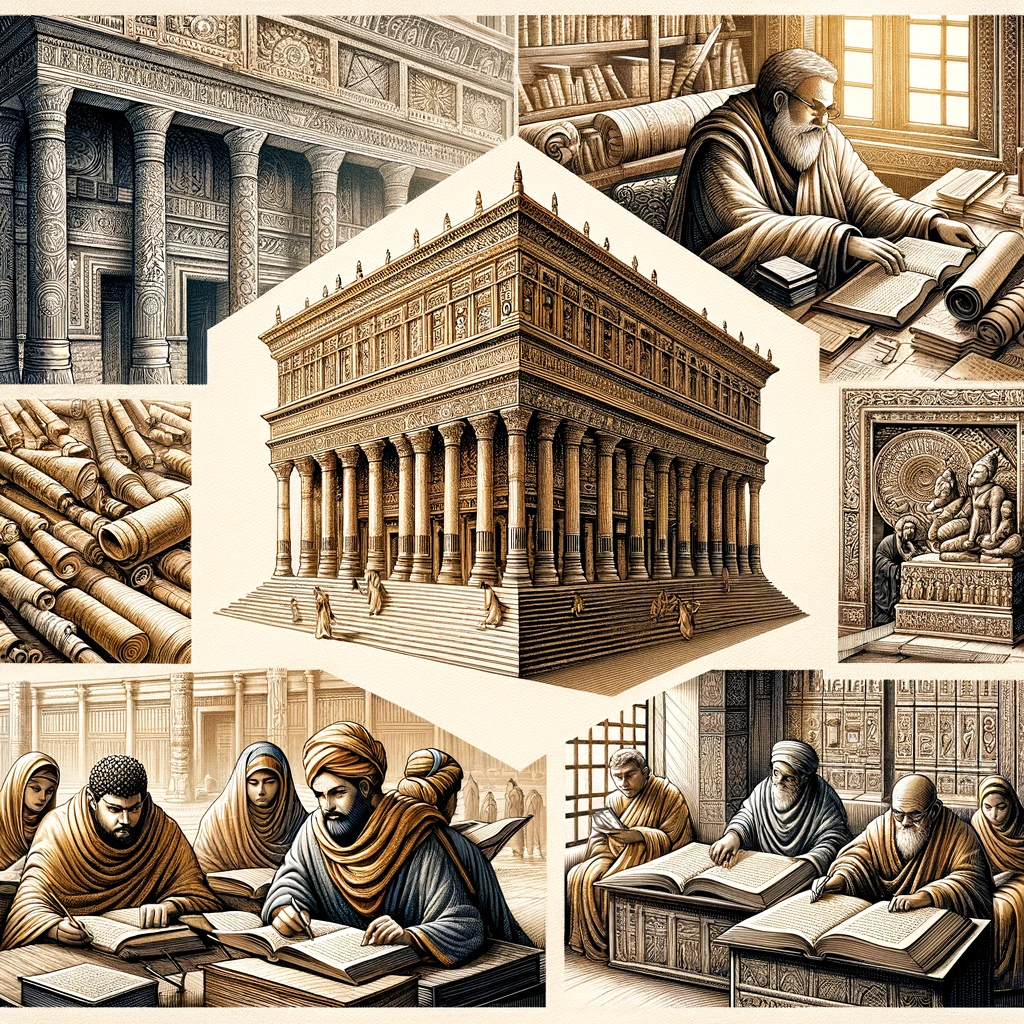
In the annals of history, ancient libraries stand as beacons of knowledge, wisdom, and cultural exchange. These repositories of ancient texts and manuscripts were not just collections of books; they were centers of learning, hubs of intellectual activity, and symbols of the pursuit of knowledge.
The Great Library of Alexandria, founded in the 3rd century BC in Egypt, is perhaps the most renowned of these ancient libraries. It was not merely a storehouse of scrolls but a flourishing center of academic research, attracting scholars from across the Mediterranean world. The library was a part of a larger research institution, the Mouseion, which functioned as an early form of a university. Its destruction, a significant loss to cultural and intellectual history, remains a symbol of the fragility of knowledge.
On the Indian subcontinent, the ancient university of Nalanda, established in the 5th century AD, housed a vast library known as Dharmaganja (Treasury of Truth). This complex was a center of Buddhist learning but also welcomed scholars of various fields from far and wide. The library was said to contain thousands of manuscripts on diverse subjects such as theology, philosophy, astronomy, and medicine, underlining the inclusive nature of ancient Indian education.
The House of Wisdom in Baghdad, during the Islamic Golden Age, was another such institution. It was not just a library but also a center of translation, where Greek, Persian, and Indian texts were translated into Arabic. This movement of translation and the knowledge preserved and enhanced in the House of Wisdom played a crucial role in preserving the classical heritage and advancing scientific and philosophical thought.
These ancient libraries, each unique in its cultural setting, shared a common purpose: to serve as a repository of human understanding and a place for intellectual discourse. They were the heart of their civilizations, places where ideas were born, debated, and preserved. The legacy of these libraries is a testament to the enduring human desire to learn, explore, and understand the world.
Reflecting on the history of these ancient libraries reminds us of the continuous human quest for knowledge and wisdom. It underscores the importance of preserving and sharing knowledge, a principle as relevant today as it was in the ancient world. As we continue to build our modern libraries and centers of learning, we draw inspiration from these ancient hubs of wisdom, which illuminated the path for generations of scholars and thinkers.
 Ruins and Relics