
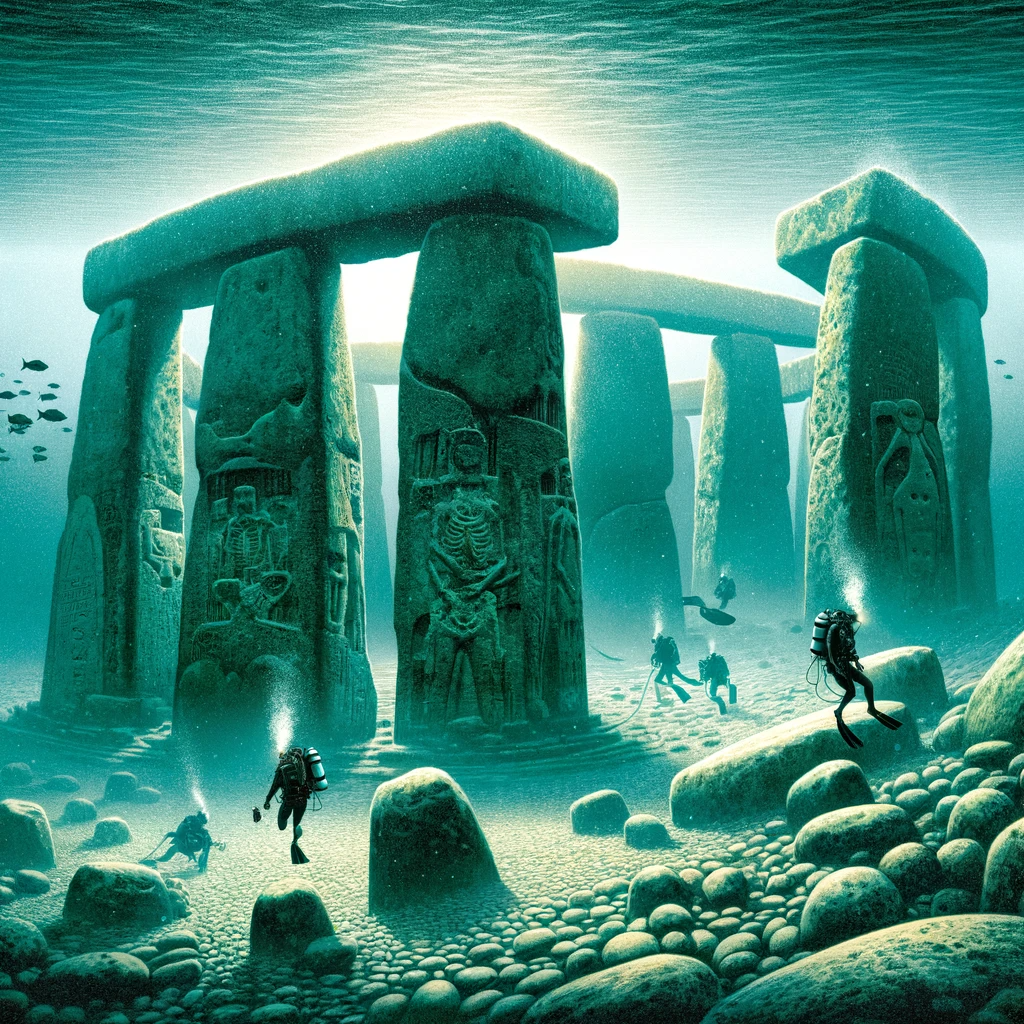
Beneath the waves of our world’s oceans and lakes lie mysteries as intriguing as any ancient legend. Among these enigmatic secrets are submerged megalithic structures, silent witnesses to a time long gone, yet still echoing with the whispers of prehistoric civilizations. Two such remarkable sites are the underwater Stonehenge in Lake Michigan and the Yonaguni Monument in Japan, both shrouded in mystery and speculation.
Discovered by underwater archaeologists, the submerged Stonehenge in Lake Michigan resembles its namesake on the English plains, with a circle of stones arranged in a familiar pattern. Intriguingly, one of the stones appears to bear the carving of a mastodon, an animal that went extinct over 10,000 years ago. This raises fascinating questions about the age of the structure and the people who built it.
Half a world away, off the coast of Yonaguni Island, Japan, lies an equally mystifying site. The Yonaguni Monument, a massive underwater rock formation, has sparked debate among scientists and scholars. Some argue that its terraces and sharp angles are the work of an ancient civilization, while others believe it to be a natural formation sculpted by the movements of the Earth.
These underwater sites challenge our understanding of prehistoric human civilization. Were these structures built during a time when sea levels were significantly lower, only to be submerged by rising waters? Could they be evidence of advanced prehistoric societies, or are they merely the product of natural geological processes?
The exploration of these underwater monuments is not just an archaeological pursuit; it’s a journey into the unknown, a quest to unravel the stories of our planet’s past. As divers navigate these ancient ruins, they bridge the gap between the present and a time when these structures stood above the water, silent sentinels at the edge of human history.
In conclusion, the underwater Stonehenge and the Yonaguni Monument stand as enigmas, challenging us to expand our perceptions of history and prehistory. They represent not just remnants of a distant past but also symbols of the enduring human quest for knowledge and understanding. As we continue to explore these submerged wonders, we may find more than just stones and carvings; we may unearth new chapters of the human story, long hidden beneath the waves.
 Ruins and Relics