
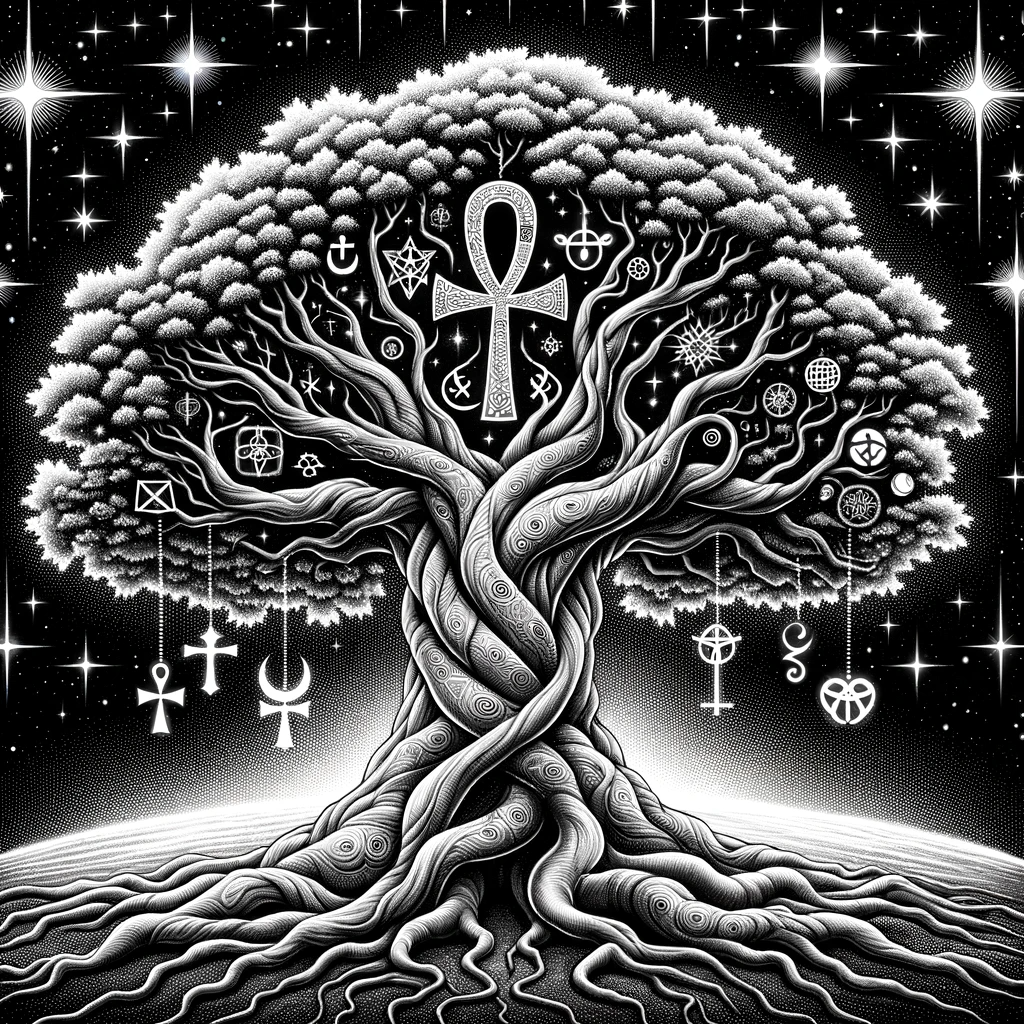
Did you know that the concept of a World Tree, a colossal tree that connects different realms, is not confined to just one culture? From the Norse Yggdrasil to the Mayan Ceiba, the World Tree is a universal symbol that transcends geographical and cultural boundaries.
The Universal Symbolism of World Trees
The World Tree is more than just a mythological concept; it’s a symbol that has been revered across multiple civilizations. Whether it’s the Ashvattha in Hindu tradition or the Tree of Life in Kabbalistic thought, the World Tree represents a cosmic axis where heaven, earth, and the underworld meet.
The Norse Yggdrasil
In Norse mythology, Yggdrasil is an immense, holy tree that connects all of reality. The roots of this Ash tree delve into various realms, including Asgard, the home of the gods, and Hel, the land of the dead. The tree is so vast that it’s said to provide shelter to various creatures, including dragons and eagles.
The Mayan Ceiba
In Mayan cosmology, the Ceiba tree, also known as Yaxche, serves as the axis mundi, connecting the celestial realm to the underworld. The tree’s branches were believed to reach into the heavens, while its roots extended into the underworld, making it a symbol of unity and balance.
The Ashvattha in Hindu Tradition
In Hinduism, the Ashvattha tree, a sacred fig tree, is revered as a symbol of existence and the eternal soul. The Bhagavad Gita describes this tree as having its roots above and branches below, symbolizing the eternal and ever-changing aspects of life.
The Kabbalistic Tree of Life
In Kabbalistic thought, the Tree of Life is a diagram that represents the ten attributes through which the infinite interacts with the finite world. It serves as a guide to understanding the nature of God and the universe.
The concept of the World Tree is a fascinating testament to the interconnectedness of human thought. Across cultures and through time, we find this recurring symbol that speaks to our collective understanding of the cosmos. It’s as if the World Tree is a shared dream, a universal myth that helps us make sense of the world and our place in it.
 Ruins and Relics